Angular Architecture Explained
Overview
Angular follows a component-based architecture that promotes modularity, maintainability, and scalability. Here’s a comprehensive overview of Angular’s architecture:
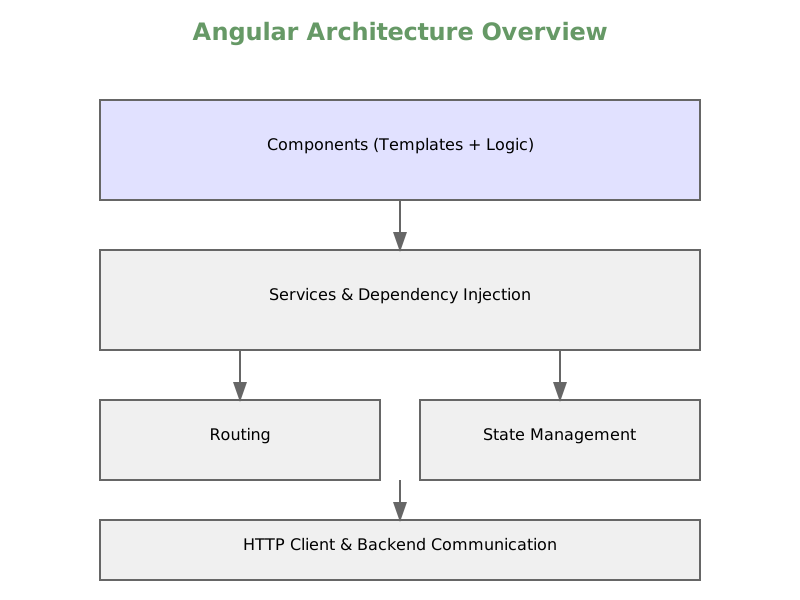
1. Components and Templates
Components are the fundamental building blocks of Angular applications. They consist of:
// Component Definition
@Component({
  selector: 'app-user-profile',
  template: `
    <div class="profile">
      <h2>{{ user.name }}</h2>
      <p>{{ user.bio }}</p>
      <button (click)="updateProfile()">Update</button>
    </div>
  `,
  styles: [`
    .profile {
      padding: 1rem;
      border: 1px solid #ddd;
    }
  `]
})
export class UserProfileComponent {
  @Input() user: User;
  @Output() update = new EventEmitter<User>();

  updateProfile() {
    this.update.emit(this.user);
  }
}
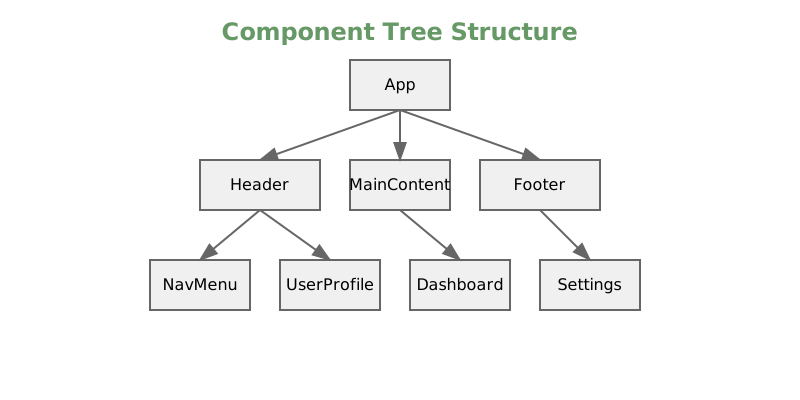
Component Tree Structure
Components in Angular form a tree structure, with the AppComponent at the root:
2. Modules
Modules in Angular help organize the application into cohesive blocks of functionality:
@NgModule({
  declarations: [
    UserProfileComponent,
    UserListComponent
  ],
  imports: [
    CommonModule,
    SharedModule,
    UserRoutingModule
  ],
  providers: [
    UserService,
    { provide: API_URL, useValue: 'https://api.example.com' }
  ],
  exports: [UserProfileComponent]
})
export class UserModule { }
Module Types:
Root Module (AppModule)
- Bootstrap component
- Core services
- App-wide providers
Feature Modules
- Domain-specific functionality
- Lazy loading support
- Encapsulated components
Shared Modules
- Reusable components
- Common directives
- Pipes
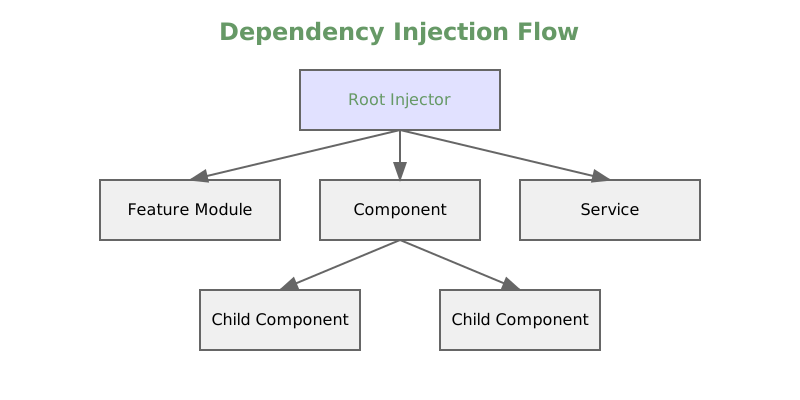
3. Dependency Injection (DI)
Angular’s DI system is hierarchical and follows the component tree:
// Service with DI
@Injectable({
  providedIn: 'root'  // Application-wide singleton
})
export class DataService {
  constructor(
    private http: HttpClient,
    @Inject(API_URL) private apiUrl: string
  ) {}

  getData(): Observable<any> {
    return this.http.get(`${this.apiUrl}/data`);
  }
}

// Component using the service
@Component({
  providers: [
    // Component-level provider
    { provide: DataService, useClass: MockDataService }
  ]
})
export class DataComponent {
  constructor(private dataService: DataService) {}
}
4. Data Flow and Change Detection
Angular uses a unidirectional data flow and Zone.js for change detection:
@Component({
  selector: 'app-parent',
  template: `
    <app-child
      [data]="parentData"
      (update)="onUpdate($event)">
    </app-child>
  `
})
export class ParentComponent {
  parentData = { value: 'initial' };

  onUpdate(newValue: string) {
    this.parentData = { value: newValue };
  }
}

@Component({
  selector: 'app-child',
  changeDetection: ChangeDetectionStrategy.OnPush,
  template: `
    <div>{{ data.value }}</div>
    <button (click)="updateValue()">Update</button>
  `
})
export class ChildComponent {
  @Input() data: { value: string };
  @Output() update = new EventEmitter<string>();

  updateValue() {
    this.update.emit('new value');
  }
}
5. Services and State Management
Services manage data, state, and business logic:
// State Management Service
@Injectable({
  providedIn: 'root'
})
export class StateService {
  private state = new BehaviorSubject<AppState>(initialState);

  // Expose state as observable
  state$ = this.state.asObservable();

  // Update state
  updateState(newState: Partial<AppState>) {
    this.state.next({
      ...this.state.value,
      ...newState
    });
  }

  // Select specific state slice
  select<T>(selector: (state: AppState) => T): Observable<T> {
    return this.state$.pipe(
      map(selector),
      distinctUntilChanged()
    );
  }
}
6. Routing and Navigation
Angular’s router enables navigation and lazy loading:
const routes: Routes = [
  {
    path: 'users',
    component: UserListComponent,
    children: [
      {
        path: ':id',
        component: UserDetailComponent,
        resolve: {
          user: UserResolver
        }
      }
    ],
    canActivate: [AuthGuard]
  },
  {
    path: 'admin',
    loadChildren: () =>
      import('./admin/admin.module').then(m => m.AdminModule),
    canLoad: [AdminGuard]
  }
];

// Router Service Usage
@Injectable()
export class NavigationService {
  constructor(
    private router: Router,
    private location: Location
  ) {}

  navigateToUser(id: string) {
    this.router.navigate(['/users', id], {
      queryParams: { view: 'details' }
    });
  }

  goBack() {
    this.location.back();
  }
}
7. HTTP and Backend Communication
Angular’s HttpClient handles API communication:
@Injectable({
  providedIn: 'root'
})
export class ApiService {
  constructor(
    private http: HttpClient,
    private errorHandler: ErrorHandlingService
  ) {}

  getData<T>(endpoint: string): Observable<T> {
    return this.http.get<T>(`${this.apiUrl}/${endpoint}`).pipe(
      retry(3),
      catchError(error => this.errorHandler.handle(error))
    );
  }

  postData<T>(endpoint: string, data: any): Observable<T> {
    return this.http.post<T>(`${this.apiUrl}/${endpoint}`, data).pipe(
      catchError(error => this.errorHandler.handle(error))
    );
  }
}
Interview Tips
When discussing Angular’s architecture in interviews:
Emphasize Modularity
- Explain how components, modules, and services promote clean code
- Discuss how DI enables testing and maintainability
Performance Considerations
- Change detection strategies
- Lazy loading
- State management patterns
Best Practices
- Smart vs. Presentational components
- Service organization
- Module structure
Real-world Examples
- Share experiences with large-scale applications
- Discuss architectural decisions and trade-offs
- Explain how Angular’s architecture solves common problems
Test Your Knowledge
Take a quick quiz to test your understanding of this topic.